Walsey Hills
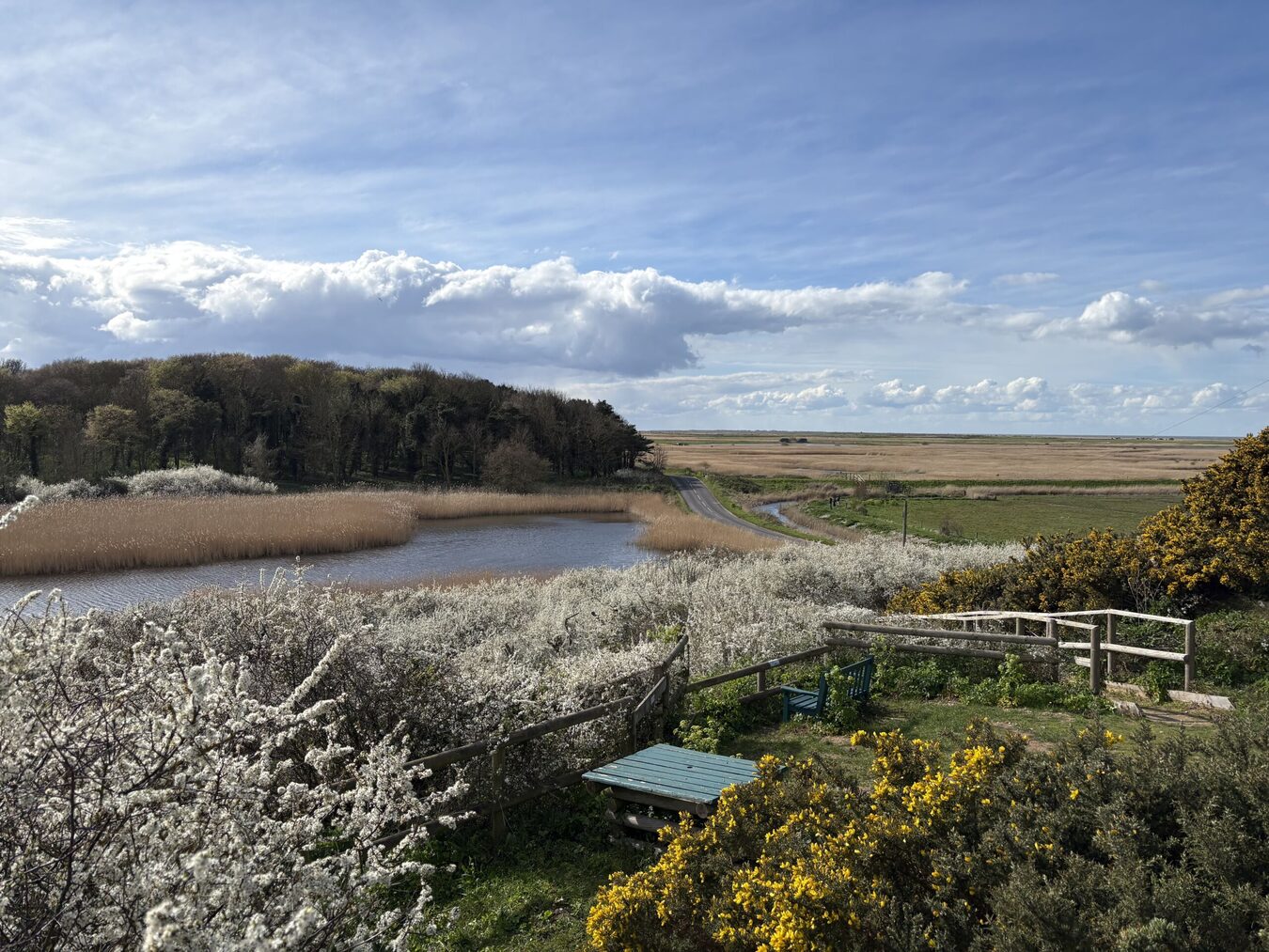
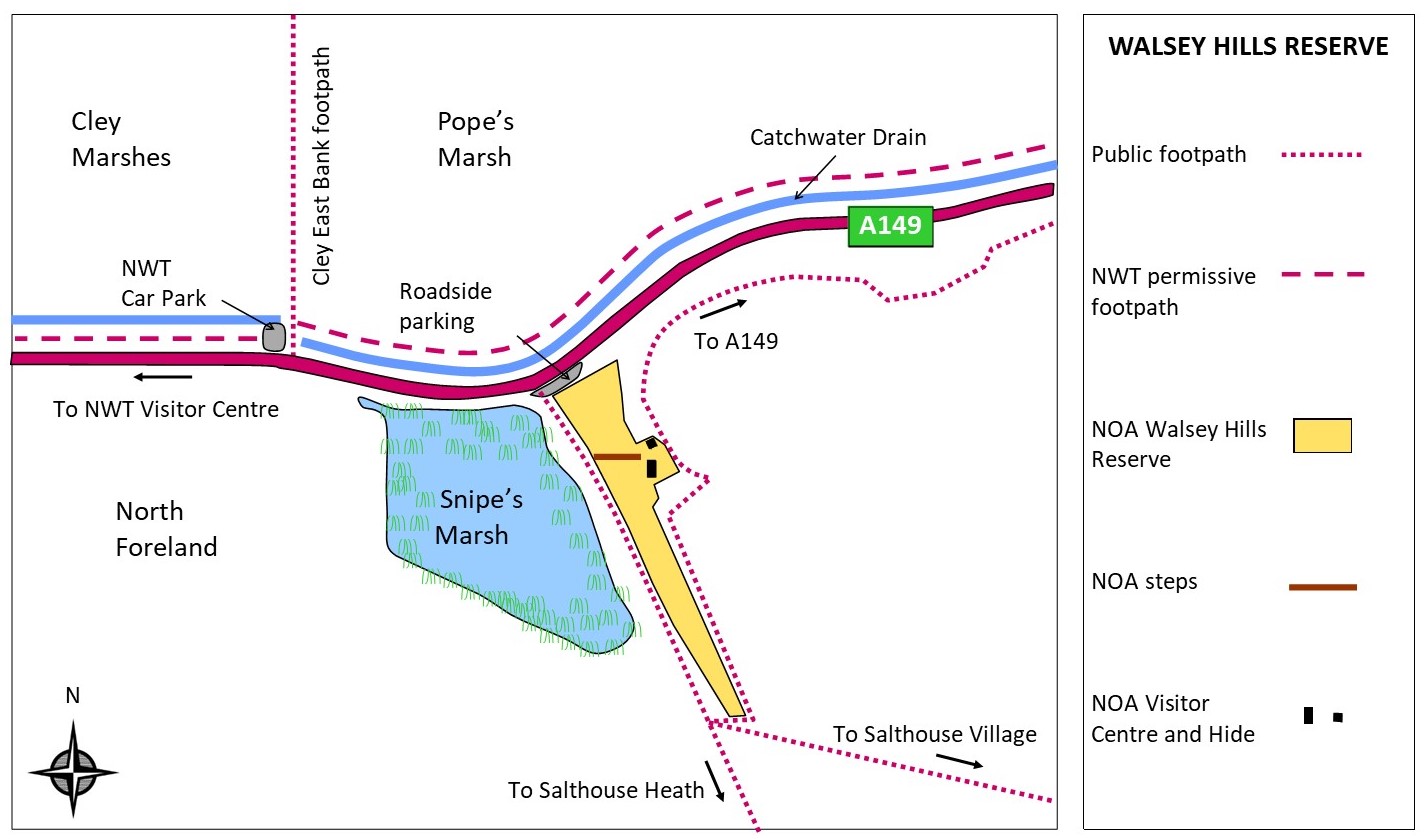
Walsey Hills Migration Watchpoint is a hillside reserve of 3 acres (1.2 ha) beside the A149 coast road, situated between Cley and Salthouse villages. Being located close to Cley’s East Bank, the site offers superb views across the coastal marshes and across Snipes Marsh to the woodland of the North Foreland.
The public footpath to the east of the reserve affords excellent views over the new Pope’s Marsh section of the Cley Marshes NWT reserve. The thorn and gorse scrub provides shelter for migrating birds, often attracting scarcer species. Besides birds, the hills are also frequented by Slow Worms, Common Lizards and a variety of insects. Birds and other Wildlife: An important migration watch-point, the site has attracted some unusual species in recent years including Red-backed Shrike, Alpine Swift, Honey Buzzard, Richard’s Pipit, Little Bunting, and Dusky, Yellow-browed and Pallas’s Warblers. More regularly Cetti’s Warbler, Pied Flycatcher, Common Redstart, and Firecrest can be found. The adjacent marshes provide habitat for a wide range of wildfowl and waders. In fields to the south, farmland birds such as Yellowhammer may be present. Reserve History: Walsey Hills was once used by the former Cley Bird Observatory and was an important ornithological site even prior to 1950. The site was used for bird ringing and monitoring, and a Heligoland trap was built here in 1951. Despite being damaged in the North Sea surge of 1953, the trap was repaired and continued to be used for bird ringing and monitoring until the end of 1963. The site is also of wider historical significance because of its Royal Observer Corps underground monitoring post (the ROC Cley-next-the-Sea “bunker”). Buildings like this were designed as fallout shelters in the 1950s, for use as monitoring posts in the event of a nuclear war. They were buried underground and equipped with scientific and communications equipment, as well as bunk beds, chairs, basic lighting and a chemical toilet, to allow personnel to monitor external conditions from the inside over a prolonged period. Built in 1958, the monitoring post was closed in 1968. The site’s ornithological role then resumed and the Norfolk Ornithologists’ Association (NOA) undertook bird ringing at the site from 1970. The NOA then purchased the site from Norfolk County Council in 1973. Now partially uncovered, the former bunker serves as a visitor centre, where bird movements and numbers are observed and recorded, together with information about insects and other wildlife. There is also a hide which was formerly an ROC aircraft monitoring station, built in 1953 on this high vantage point. The hide was rebuilt in 2004, using funds from the NOA and its supporters, and can be used by members visiting the reserve. The steps leading up the hill from the public footpath to the bunker were extensively repaired in 2001, and then replaced to a high standard in 2009 thanks to a grant from Awards for All, one of the National Lottery’s award schemes. The reserve is open from dawn to dusk, during which time you are most welcome to visit, to enjoy the wildlife and the views over the surrounding countryside. When a warden is present, you will also be able to access the observation hide and visitor centre. NOA members who have a hide key will be able to access the hide at other times. Non-members visiting when a warden is present are invited to contribute to the upkeep of the reserve. In the event of a rarity being present, the NOA reserves the right to charge a permit fee for non-members accessing Walsey Hills. Anyone wishing to visit the former ROC structures is urged to contact the NOA well in advance, to arrange a visit when a warden can provide access, although both buildings can be viewed externally at other times when the reserve is open. Access Information Walsey isn’t manned regularly but visitors are welcome to visit the reserve. Walsey Hills is accessed via a long set of steps but these provide handrails and resting points for those with reduced mobility who are still able to make their way up on foot. Please be aware that this is a hillside site, and we regret that wheelchair access is not feasible. The bunker is reached by a flight of 46 wooden steps; the gradient of the steps is relatively gentle, and there are two landings, each with a small bench on which to rest. There is a further flight of 13 steps to reach the hide. There are no rights of way on this reserve, but three sit near to its boundaries. Visitors are asked not to cut through between the surrounding public footpaths, this damages fences and disturbs wildlife. Your co-operation is appreciated. Dogs are welcome on leads. Directions and facilities Walsey Hills is situated on the A149 midway between Cley-next-the-Sea and Salthouse. The reserve is signposted, and parking is available on the roadside adjacent to the reserve (sometimes also in the small NWT car park at the south end of the East Bank). The nearest toilet facilities are half a mile west along the main road at Cley Marshes NWT Visitor Centre on the A149, which can be reached via the NWT’s permissive footpath from the East Bank. Grid reference: TG062441. Grid ref of carpark TG062442.