Thermal Imaging Report 2024
for as little as 14p per day.
9th February 2026
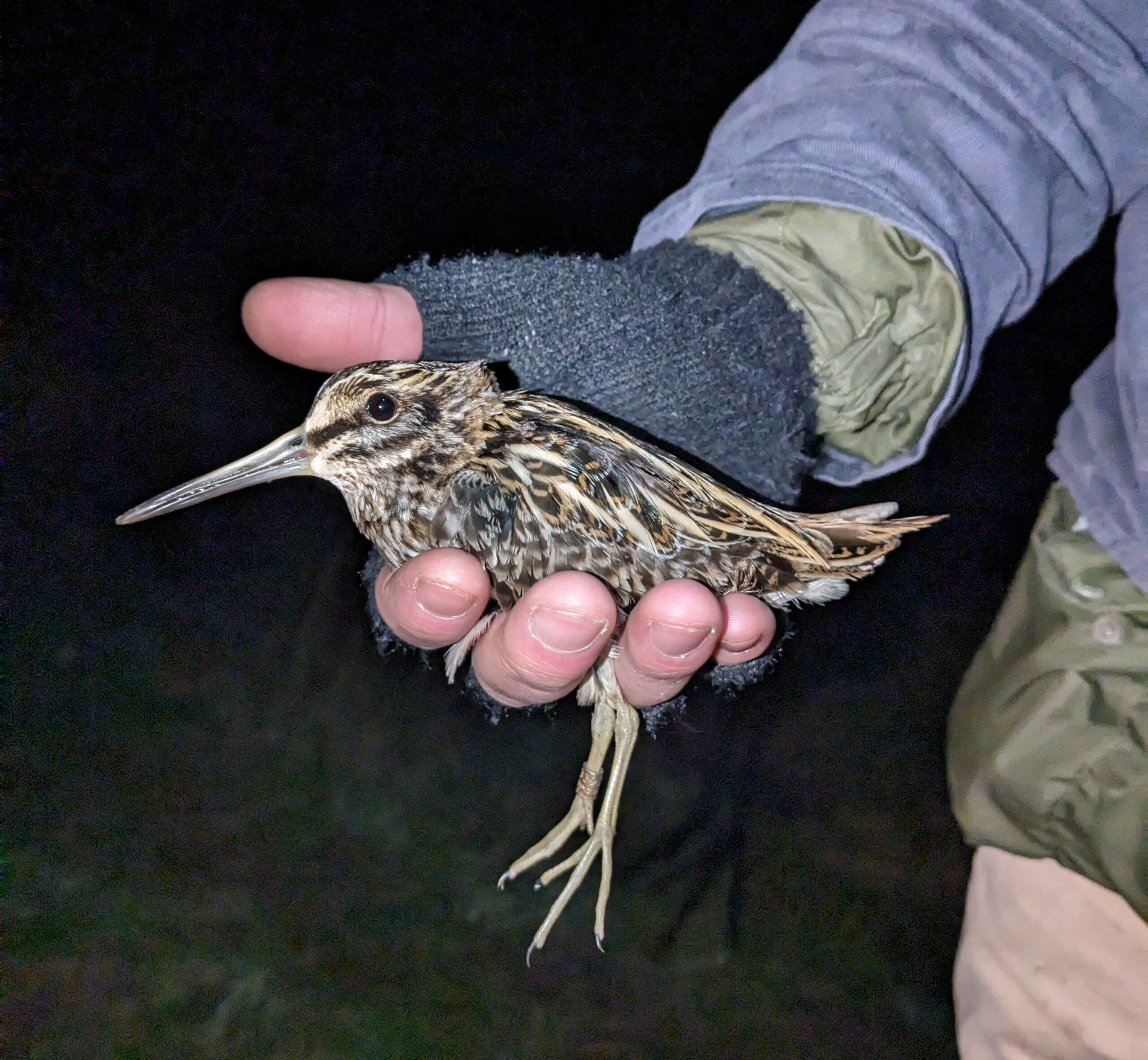
Finnish Jack Snipe
During the winter of 2023-24, Ed and I started learning how to use the NOA thermal imager to catch birds and we produced this report for the 2024 annual report that just came out a few months ago, but I wanted to post on the website so the report is more widely available.
The thermal imager was kindly funded by Jim Fergusson in 2022.
What is thermal imaging/dazzling?
This method of catching birds, involves going out in the evening once it is dark, using the thermal imaging camera to detect a heat source and attempting to approach the bird (as silently as possible!) using a strong torch which creates a dazzling effect – i.e. the bird can’t really see you approaching. Once you get close enough, and if the bird hasn’t yet flew away, you can then use a large net with a long pole called a landing net and pop it down over the bird to catch it. Although it sounds pretty straightforward, it’s quite a difficult thing to master, and we’ve had many failed attempts.
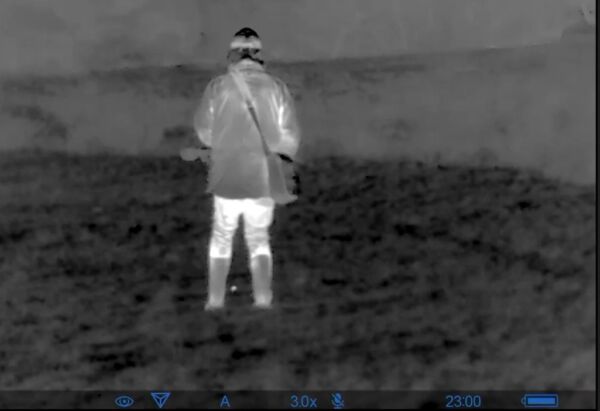
Image of Ed through the thermal imager, having approached a bird getting ready to catch
How to pick the perfect night?
The weather plays a big role – ideally you want a really dark night with heavy cloud, and no moon or else you can be extra visible to the birds. You want a site with little light pollution, as this can also make it really difficult to get the perfect dark conditions. A little bit of wind helps muffle the sound of you approaching a bird, but too much wind can make it difficult to use the landing net effectively. Light rain can also help mask your approach, but then you must take extra considerations around the welfare of the bird. So, it’s all a bit of balance! We found our most productive nights to be dry and cloudy with a gentle breeze.
Bird welfare is our priority and limiting disturbance is key, so we therefore restrict visits for this kind of ringing so that visits aren’t made on subsequent nights to the same site and not during periods of cold weather when birds need to focus on feeding.
What birds to use this method for?
This method is extremely effective with Woodcock and Jack Snipe, and to a lesser extent Common Snipe, as for whatever reason they are a little bit more savvy and often fly off before you can get close enough. As Woodcock, Jack Snipe and Snipe come out at night to feed in open areas, dazzling makes a really useful technique for catching them. That said, you never know what you will find!
So, our focus was on catching Woodcock and Jack Snipe, as they are very challenging to monitor in any other way, Jack Snipe especially as they’re so secretive and difficult to see.
Where?
We focused effort on catching at Redwell Marsh, Hempton Marsh and the small bit of land we have at Kelling. As we started to experiment, we found out that Redwell Marsh was really good for both Woodcock and Jack Snipe. Hempton Marsh is an amazing and important site for Woodcock, we had 10+ Woodcock all out feeding one night. Kelling is also good for Jack Snipe.
What did we catch?
Since starting to use the thermal camera we have made 31 captures, across winter 23-24 on the three NOA sites. Of these 18 were Woodcock, 8 Jack Snipe, 2 Common Snipe, 1 Grey Partridge, 1 Starling and a surprise Teal! We also came close to Dunlin and Skylark, although we don’t see many of them. All of the birds we did catch, with the exception of one, were new birds….
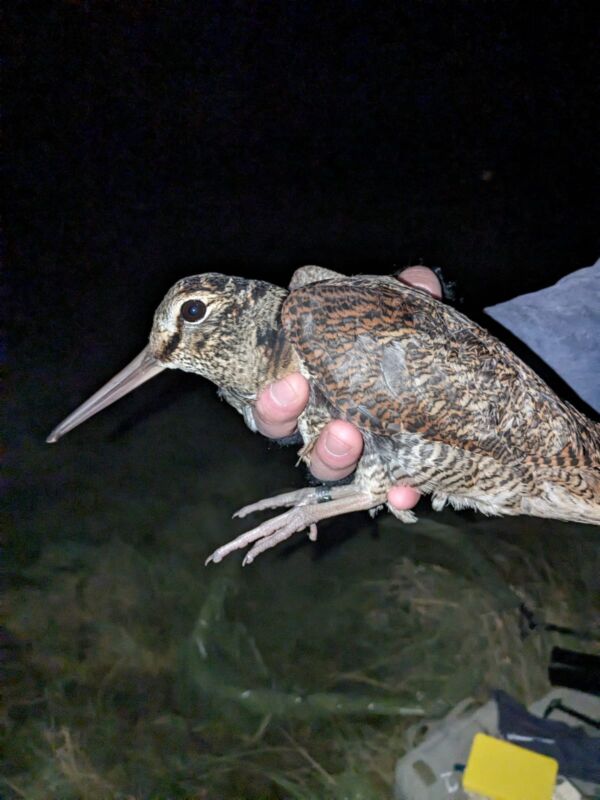
Woodcock
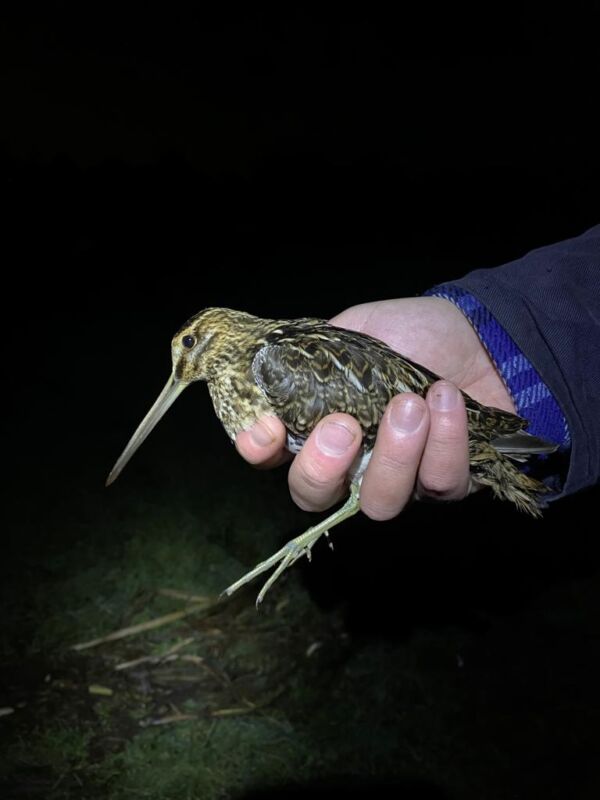
Common Snipe
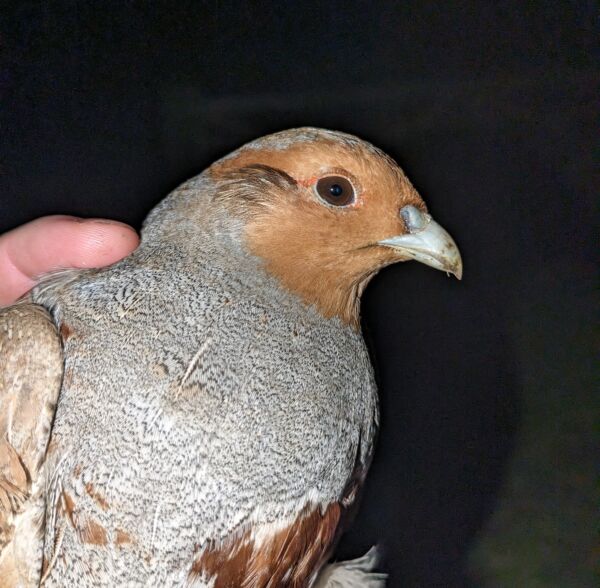
Grey Partridge
Finnish Jack Snipe Story
Only catching new birds all changed on the evening of the 1st of February 2024 when we headed out to Redwell Marsh. The evening started off well with a Jack Snipe and Woodcock caught and ringed pretty quickly after arriving on site. We then had an hour of walking around and not really coming across anything we could catch until Ed came across a possible heat source and approached the bird. Ed made the catch and after I ran across to help, and he said, “it has a ring on it!!” So, I thought it must be a recapture, a bird we had caught and ringed here previously, but it wasn’t… It was a control (ringed at another site), and it had a Finnish ring on!!! We couldn’t believe it. With a bit of an adrenaline rush, we wrote down the ring number and processed the bird as usual (age, measured wing and weighed the bird) and released it within a couple of minutes, with a quick picture before release of course….
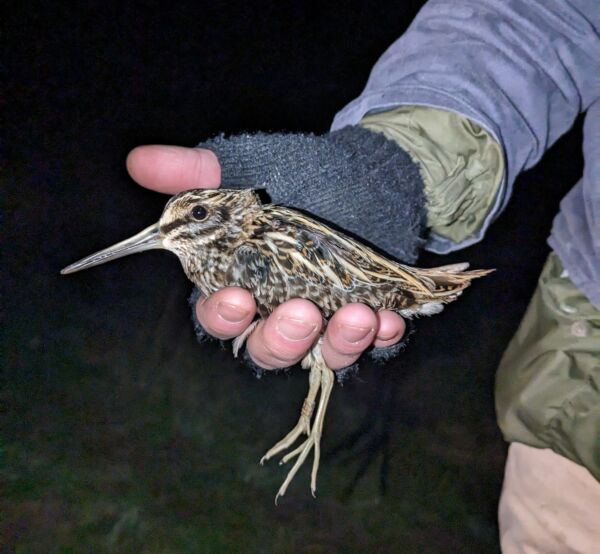
Finnish Jack Snipe before release. Note the brown staining on the ring, Finnish peat perhaps….?
Delighted, we finished the loop of the grazing marsh catching another Jack Snipe, before we headed back to the car. Immediately, I went on to a thermal imaging group on Facebook for ringers from all over the world, that use thermal imaging to discuss different methods and what they catch. I wrote a post about our Finnish Jack Snipe, asking if it was anyone on the groups bird, and within minutes, a ringer, Laura Oinas, who ringed the bird in North Karelia, had replied! Amazing result. She ringed the bird as a juvenile in October 2023. Sadly, we learned that the place our Jack Snipe was ringed was likely going to be a solar farm in the next few years and looks to currently be in pre-development, but hopefully this ringing recovery goes some way to show the importance of the site for breeding Jack Snipe.
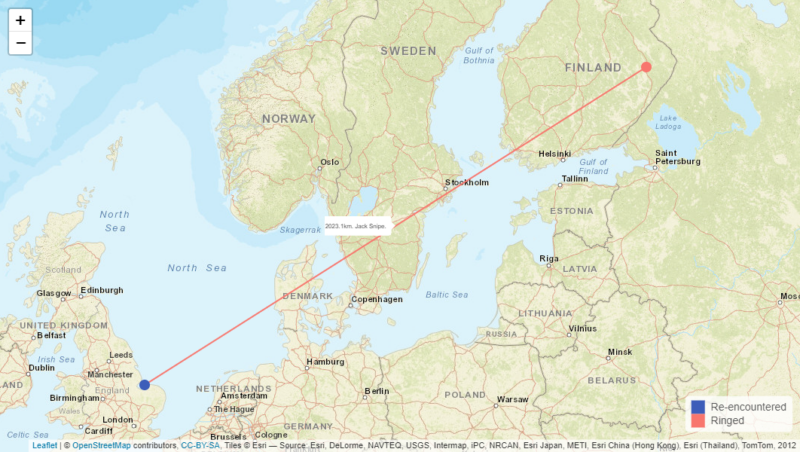
The movement of our Jack Snipe from Finland to Redwell Marsh
We believe that this was only the 3rd Finnish-ringed Jack Snipe ever controlled in the UK, and just the 29th foreign-ringed bird from anywhere else in Europe, which makes the recovery even more amazing. Due to the difficulty in surveying for Jack Snipe, little is known about their wintering habits in Britain, and we hope that further work on NOA sites will contribute further to our understanding of this magnificent little bird.
Finnish magazine article
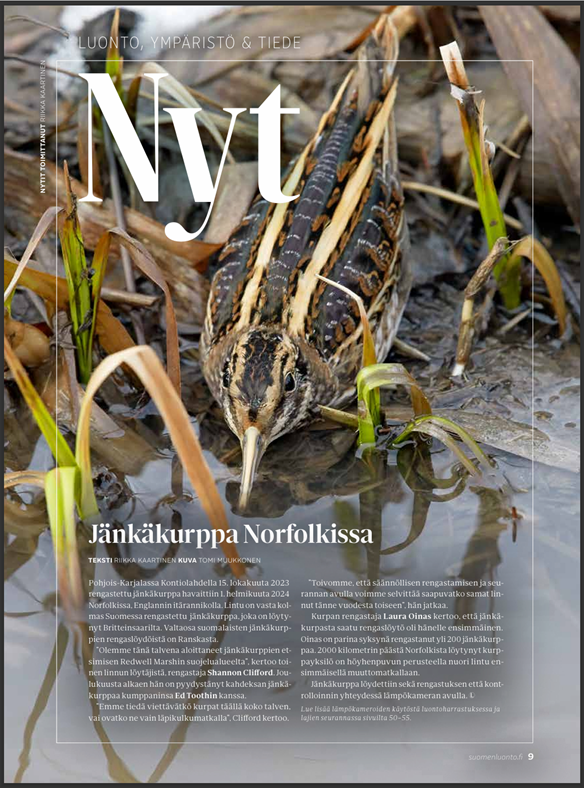
Not long after all this happened, I was contacted by Riikka Kaartinen, an editor for Suomen Luonto, “Nature of Finland”, Finland’s largest nature magazine, after she heard the story about us catching the Jack Snipe. They produced a lovely article on the story (see below) after doing an email interview finding out all about how we caught the bird and what we hoped to learn from it.
We have made several thermal visits this winter to Redwell Marsh. However, the birds just weren’t around earlier in the winter so it highlights how seasonal birds feeding habitats can be. The prolonged dry summer and autumn meant a lot of the habitat wasn’t suitable for feeding as it was so dry. We are hoping going forward to create a programme of standardised thermalling effort to our sites.
Report by Shannon Clifford (Warden) and Ed Tooth (Trustee and volunteer)