NOA New Years Sponsored Birdwatch 2026 Report
for as little as 14p per day.
5th January 2026
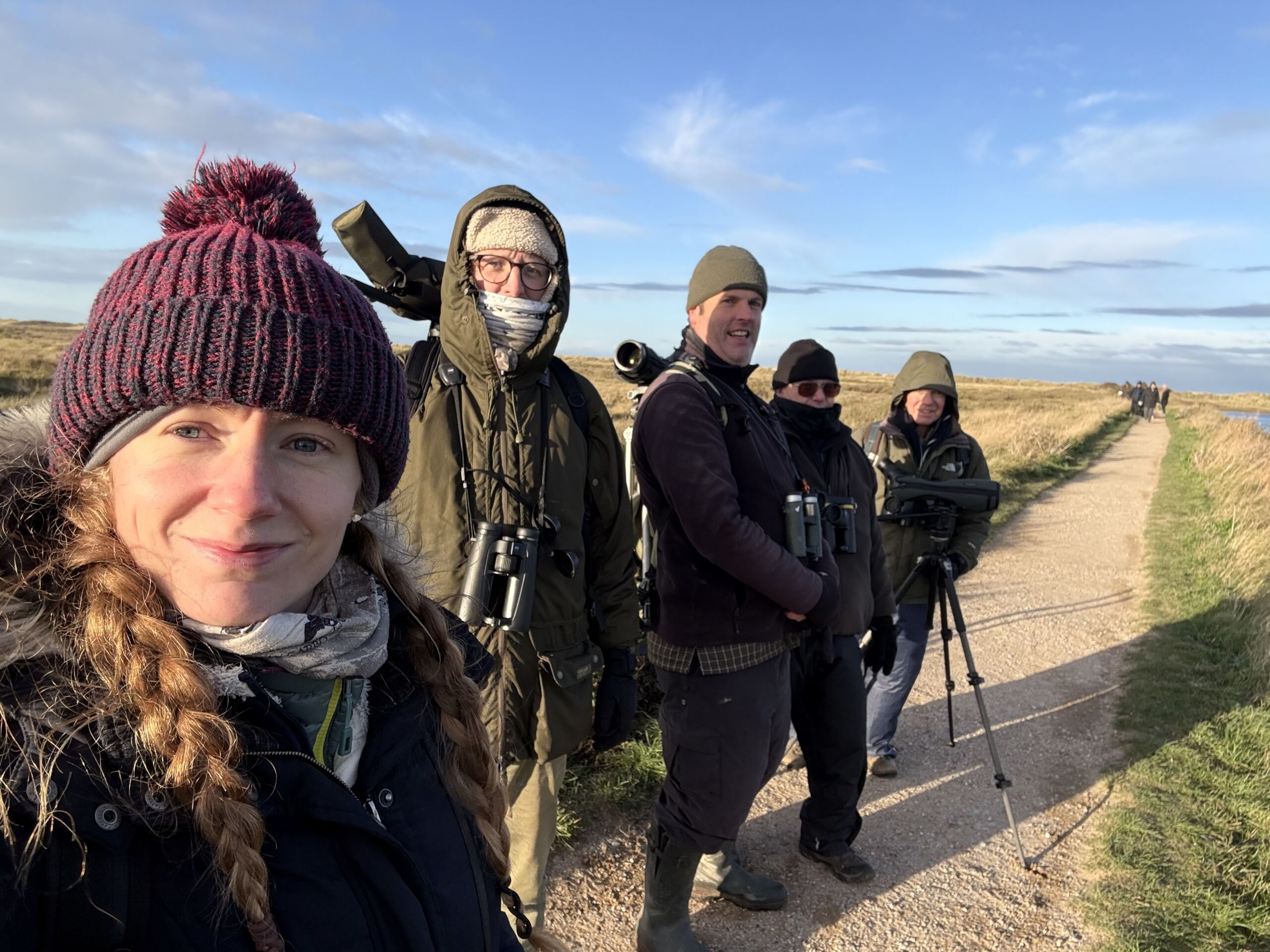
Team NOA
Things have been all change at the NOA recently and this year we decided to hold our annual sponsored birdwatch to raise money for the Observatory on the 2nd of January 2026 instead of the usual Christmas Eve. This was the first year I’ve been involved in the sponsored birdwatch as Warden, and the pressure was on to try and see 100 species! In the days leading up to the birdwatch I was worried for a couple of reasons. Unlike other years, there were very few bird ‘specialities’ around to help get us over the magic ‘100’ target, and the weather forecast was pretty bleak to say the least – temperatures close to freezing, wind chill making it feel like -8 degrees and possible snow forecast, yikes! Not an ideal mix for a sponsored birdwatch when you’re out from sunrise until sunset exposed to the elements all day…
We decided to add some new rules in this year, chiefly that a majority of our team had to see a bird (3 out of 6 team members) for it to be added to the list, and we were birding locally from Holme to Titchwell with a few slightly inland sites (Ringstead, Hunstanton Churchyard and Choseley). Our team consisted of me, Ed Tooth, Ben Rackstraw, Steve Newman, Dave Nurney and Roger Skeen.
Our alarm went off at 0600 at home, and as we headed to the car, Ed saw one of our local Tawny Owls in the woods beside our house, and I thought ‘oh, this is a good one to get early!!’ but then immediately realised of course it wouldn’t count, so we just hoped at this point we would get Tawny Owl later in the day. A good omen perhaps?
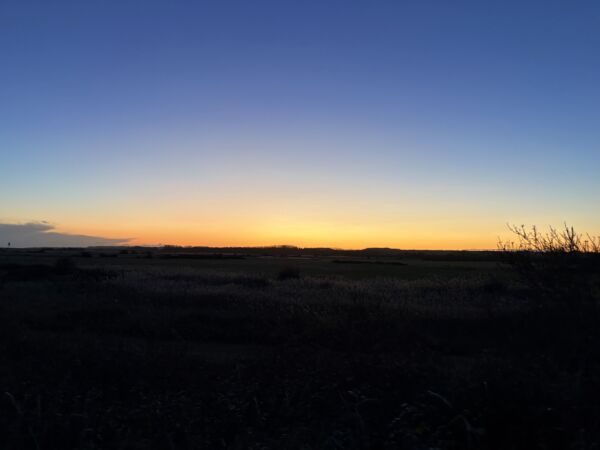
Sunrise over Holme Grazing Marsh
Upon meeting up with the rest of the team at the start of the NWT entrance track at 0730 we were all immediately cold and wondering whether this was a sensible idea. There was some scepticism about whether we would get anywhere near our target given the conditions. With the proverbial cobwebs – rather than being blown away for the New Year – frozen to our faces by the wind and sub-zero temperatures, we headed to the beach.
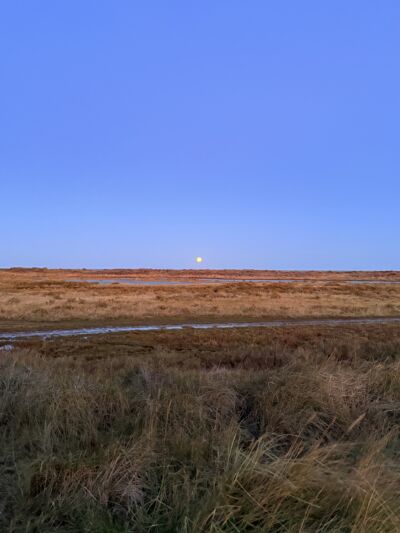
Moon over Gore Point
En route to Gore Point we added Pink-footed Goose, Mallard, Redshank, Magpie, and Teal. The tide was high, but the sea was quiet and conditions made looking through our scopes extremely challenging. However, we added Fulmar, Cormorant and Kittiwake to the list, which was a nice bonus! Due to the conditions, it didn’t feel worthwhile continuing and we decided to walk east up the beach.
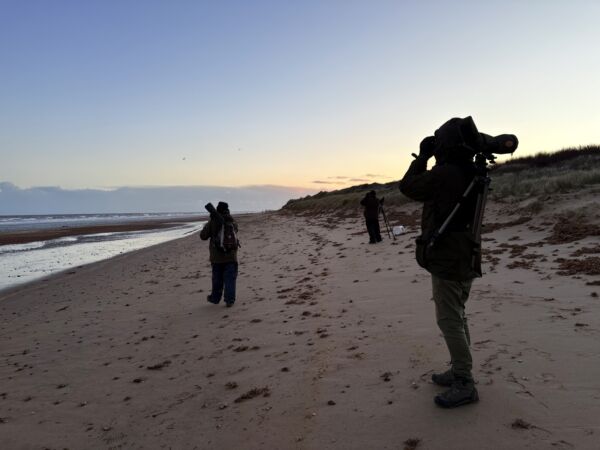
Ed, Steve and Dave hard at work!
We had a scan along the beach and added the usual resident waders including Oystercatcher, Grey Plover, Bar-tailed Godwit, Turnstone, Knot, Sanderling and Dunlin, all feeding along the tide line, lovely. The usual gull species were also present including Black-headed, Common, Herring and Great Black-backed Gull. No sign by this point unfortunately of any Snow Bunting, which had occasionally been seen here in the week previous.
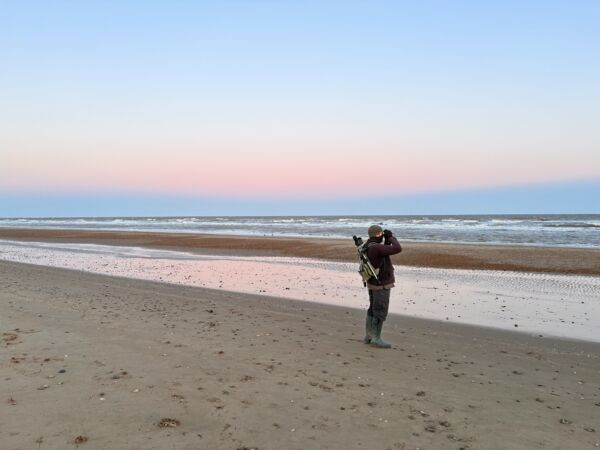
Ben scanning the beach
Due to time constraints we decided to head back to the cars, adding Wigeon and Little Egret, and then drove up the track to the Obs, to have a look around the Obs and then attempt another seawatch in the dunes, which can be much more sheltered in a north westerly.
As we were sorting ourselves out in the car park, much to our delight, two Snow Bunting flew over, heading towards the beach. These would shortly be followed by another 17, with the flock of 19 birds later being recorded on the beach. We thought after not having any at Gore Point we would miss them off our list, and although there was a chance of getting them at Titchwell later, it was a relief to get them so early on! Once we reached the Pines, Ben spotted a Stock Dove crashing out the trees along with Woodpigeon and Jackdaw, and Dave pointed out a Red Kite flying over. We headed slowly along the Broadwater checking for the usual residents and added Tufted Duck, Coot and Little Grebe, and Blue and Great Tit around the Obs feeders.
After a disappointing start to our search for species that we could get on the sea this morning, we attempted another seawatch. I was immediately relieved when we got there as it was so much more sheltered and easier to look through our scopes. I quickly found a couple of Red-breasted Merganser, and Ed found four Eider on the sea and then we had some distant Common Scoter and one Red-throated Diver past. There were also some Brent Geese on the sand bank towards Thornham.
Having secured most of the expected species on the seawatch we headed back slowly along the Observatory path and along the Broadwater. Dave had hung back and found a Stonechat so a few of us ran back to see it, before running back to the dell to try and see a Song Thrush Ben had just found. We also added Chaffinch, Goldfinch, Goldcrest, Coal Tit and Greenfinch around the dell/Pines. We had a quick look from the hides before leaving and Steve spotted an inconspicuous Shoveler and we also added Gadwall, which can be an elusive duck at this time of year. Otherwise, it was quiet around the Observatory but before we headed off, we also added Linnet, Wren and Blackbird. By 0930, we ended on 51 species just within the Holme Bird Observatory recording area, not a bad start at all! We headed off to Old Hunstanton Churchyard.
Very quickly after getting out the car at Old Hunstanton Churchyard we added Moorhen on the half-frozen duck pond, which was being very elusive at Holme. A family of Long-tailed Tit were in the large trees, and later a couple of Redwing flew over before sitting in the treetops. We added a noisy Jay from the nearby woods, and a Sparrowhawk also shot over! Delighted, we departed and went onto drive some of the backroads around Ringstead Downs/Choseley area. Steve had scouted out some set aside in the days leading up to the birdwatch, so we were happy to find the area still full of birds and we added House Sparrow, Starling and Brambling amongst a mega finch flock, and our first Marsh Harrier of the day.
We stopped at some crossroads on the Ringstead road, and I found a beautiful Bullfinch hopping about the floor and then onto the Bramble, lovely! We continued towards Choseley, and added Red-legged Partridge, Lapwing, Rook (which can be a very tricky bird to get), Crow, Skylark, Reed Bunting and a surprise Peregrine hunting over the fields! Ben had a Yellowhammer fly over calling but unfortunately, we all completely missed it so we couldn’t count it. We searched for Yellowhammer for a bit longer in the hedgerows but no such luck today and we reluctantly headed off to the next stop.
We decided to stop at Thornham to try and get a few more species that we hadn’t managed to get elsewhere yet. Ben spotted some Golden Plover over the saltmarsh, and then Ed shouted, ‘Ringed Plover!’ and one flew over our heads and onto the pools briefly. We had a very abiding Rock Pipit and Pied Wagtail at the Pools. En route back to the car, Ben picked up a single Snipe flying over. In Thornham Channel we had a Black-tailed Godwit and a very close Greenshank. As we started to head off, Ben saw something he wanted to check quickly, so jumped out the van and went over to the channel and unbeknownst to us, he had just spotted a Kingfisher and we heard cries of ‘Kingfisher, Kingfisher!!’ but by the time we got out the van, it was gone, and therefore we couldn’t count it, ugh! So moral of the story is, never split up doing a birdwatch! However, all in all it was a very productive stop and by this point we were at 81 species, so we departed to Titchwell, via checking a field for Cattle Egret (which we missed but did add distant Canada Goose!) with a fair amount of work still to do.
Titchwell, our final stop! An amazing birding spot, we started positively with a few species we felt guaranteed to secure. Ben and Steve found some Egyptian Geese in the Paddocks. Ed and I went to get some hot drinks for everyone as after birding for 6 hours in the cold we were all in need of a caffeine and heat boost. Steve, Dave and Ben went off to check for the infamous day roosting Tawny Owl which they easily got lovely views of in the dense ivy covered tree, and also to check for Firecrest which had been reported regularly in recent days. Roger went off to scout for Water Rail in the ditch, which he of course found, so Ed and I rushed round to the main path – which had now attracted quite a crowd – and got amazing views of this very confiding Water Rail feeding in the ditch. Ben, Dave and Steve eventually got great views of a Firecrest, and Ben had heard a Treecreeper which the rest of us missed, ah!!
We then added some of the usual suspects scanning from the main path including Greylag Goose, Pintail (which were doing a fabulous job of sleeping and hiding in amongst the other ducks), Pochard and Great White Egret. Redemption soon flew over us, in the form of a lone Cattle Egret, and the Avocet that had been around previous days kept us on tenterhooks, hiding on a tiny island on the tidal marsh, making us wait until the very end of the path to see them. 93 and counting…..
We worked our way along to the beach. Conditions were still tricky (to put it mildly) with not much shelter. Between the sand blasts in the face, we were starting to doubt whether we would get close to 100, but things changed quickly when we picked up a drake Goldeneye and three Long-tailed Duck, both of which were sitting just beyond the surf and were extremely tricky to pick up, as they were just continually being lost behind the waves. As an added bonus, whilst we were sitting seawatching a couple of Snow Bunting dropped onto the beach very close to us!
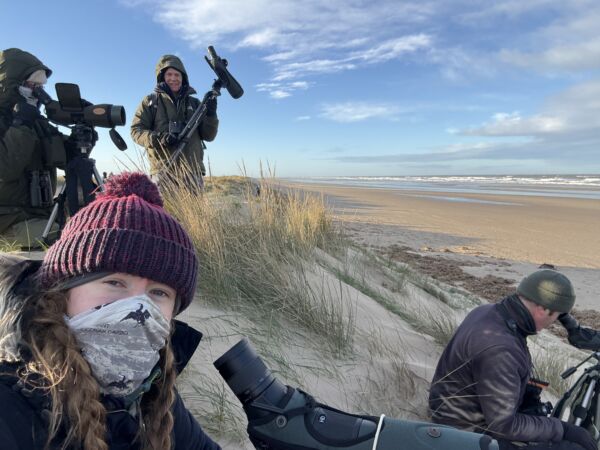
Now sitting at 95 species, we had a decision to make. We knew we had got all we could from the sea (apart from Great Crested Grebe, which is usually a nailed-on certainty in calm conditions) and, because we were beyond frozen by this point, we headed back to have a quick look from the hides. At this point, and in fitting tribute to the conditions, it briefly started snowing. Conversations turned to our longing for Mute Swan or Collared Dove. Was a Grey Heron too much to ask for! Soon after we arrived at the hides, a flock of geese appeared, and we were completely delighted to find that they were Russian White-fronted Geese! Absolutely stunning birds and we were treated to such lovely views. 96, and a glimmer of hope returned to everyone….
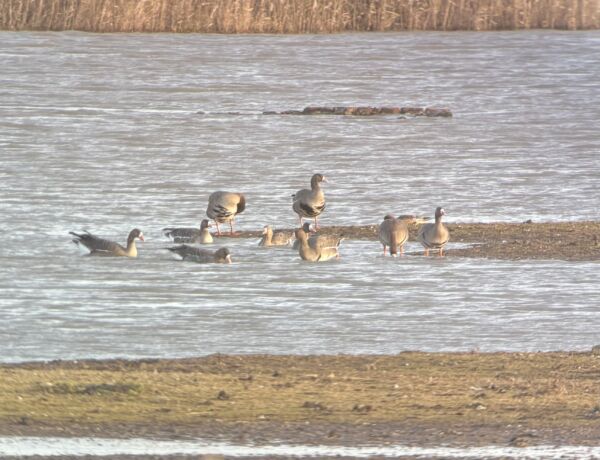
The stars of the day, Russian White-fronted Geese!
We headed back to the woods again to check for Treecreeper, lamenting that the Mute Swan were sticking to hiding in the reedbed and not coming out. We didn’t hear or see anything small and speckled, but soon a sound which is not normally associated with pure elation met out ears, a singing Collared Dove! 97, but the light was fading fast…
We went round the hides to Patsy’s to check for Mute Swan (I never thought Mute Swan could be this elusive!), and with no luck here either we were starting to feel deflated. We got stuck on 97 species by this point, and for what felt like a long, long time made no progress with adding anymore species. We decided to head back along to the benches on the main path as the sun was setting. We thought we had got to the point where we needed to rely on roosting gulls to get us over the line. I had a brief glimmer of hope picking up a Grey Heron which appeared above the bund for a moment before dropping again out of view, no one else had managed to see it in time. As we started to lose the light, Ed spotted a couple of Ruff on the islands. Then, another flock of geese flew in and Ben shouted Barnacle Geese! Another species that had been around the previous day had decided to return. Get in! 99 species, but we couldn’t pick out anything other than the usual species in the gull roost.
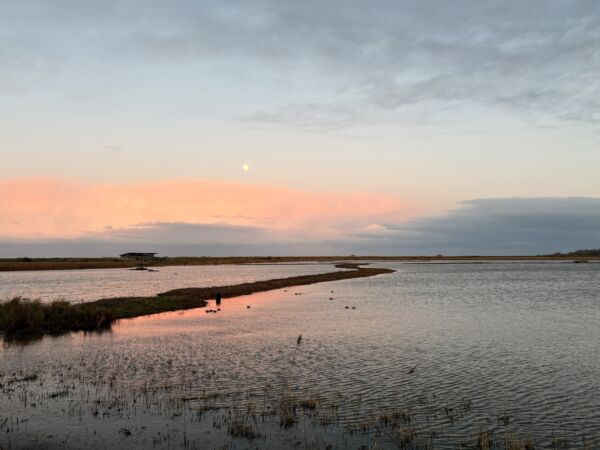
Sunset over Titchwell
We decided to head back along to the car park and try and get Woodcock at dusk, surely our last chance at 100. As we walked along the west bank path, there was a stunningly beautiful wintery sunset. Ed stopped to enjoy it, then, as if by some poetic justice for suffering in the freezing cold all day, a tiny, sickle-shaped silhouette emerged from the west, tussled briefly with a Kestrel in front of the setting sun, then shot off across the saltmarsh. A Merlin! WE DID IT, our one hundredth species!! Congratulations were had all round, and we headed off back to the car feeling a massive relief. At the car park we had a beautiful Barn Owl fly over low, and then to top off an amazing day, two Woodcock emerged from their day roost in the woods, away to feed for the evening. Wonderful!
It turns out, the official record keeper (who shall remain nameless to save embarrassment) had missed Red-throated Diver off the list, so, we actually ended on 103 species seen by a majority of the team, and 107 species recorded in total with the additional four species being Kingfisher, Yellowhammer, Treecreeper and Grey Heron. We had a great day out, despite the weather, seeing some lovely birds with personal highlights including Long-tailed Duck, Goldeneye, Russian White-fronted Geese and Snow Bunting. I want to thank Steve, Ed, Ben, Dave and Roger for all their birding skill helping to surpass the 100 mark! I also want to thank everyone and our members who have supported us and donated so far, it is very much appreciated.
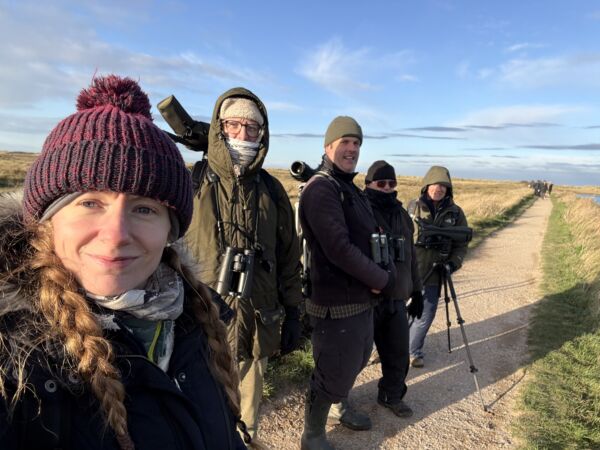
Sponsored Birdwatch Team!
If you would still like to donate towards the Sponsored Birdwatch you can do so here: https://noa.org.uk/donate-leave-legacy/
Many thanks for your support!
Shannon Clifford – Warden